UN Chief Urges U.S.–Iran Restraint in Cairo, Warns Regional Tensions Threaten Red Sea Trade
New York- Paula Sweis -From UN
CAIRO, Egypt — United Nations Secretary-General António Guterres called for renewed diplomatic engagement between the United States and Iran on Monday, warning that further military escalation could destabilize the Middle East and create wider consequences for international security and trade.
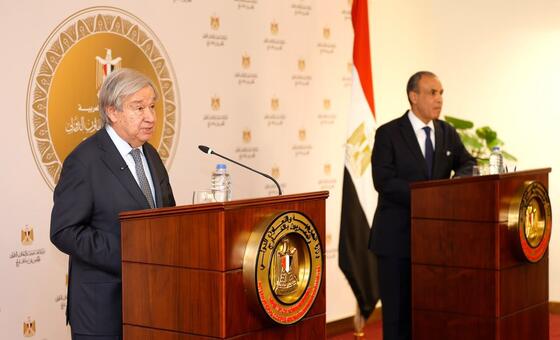
Speaking at a joint press conference with Egyptian Foreign Minister Badr Abdelatty, Guterres emphasized the importance of restraint as regional governments continue efforts to prevent another major confrontation.
The Secretary-General welcomed Egypt’s diplomatic engagement with Washington and Tehran, recognizing Cairo’s role in facilitating communication and encouraging negotiations during a period of heightened tensions.
His remarks followed discussions with Egyptian President Abdel Fattah el-Sisi on regional security, the Palestinian situation, and ongoing conflicts across the Middle East and Africa.
Regional Stability and Maritime Trade
A central concern raised during the visit was the security of international maritime routes, particularly the Strait of Hormuz and the Bab el-Mandeb Strait, which connects the Red Sea with the Gulf of Aden.
Guterres called for the restoration of freedom of navigation through both waterways in accordance with international law.
The maritime corridors are essential to global commerce, energy transportation, and regional supply chains. Continued instability around these routes carries economic implications extending beyond the countries directly involved in the conflicts.
For Yemen and neighboring Red Sea states, the Bab el-Mandeb Strait remains particularly significant because of its strategic position between the Arabian Peninsula and the Horn of Africa.
The Secretary-General’s warning underscored how regional military tensions can affect international shipping, trade activity, and economic stability even when diplomatic efforts remain underway.
Gaza and the Occupied West Bank
The discussions in Cairo also addressed the humanitarian situation in Gaza, where Guterres recognized Egypt’s continuing role in mediation, humanitarian assistance, and medical evacuations.
He urged the removal of Israeli restrictions affecting aid deliveries and called for progress in implementing the internationally supported framework aimed at ending the conflict.
The Secretary-General expressed concern over developments in the occupied West Bank, including settlement expansion, Palestinian displacement, rising violence, and attacks affecting civilians, journalists, and diplomats.
He reiterated that lasting regional stability requires a political settlement recognizing Palestinian self-determination and the establishment of two states living alongside one another in peace and security.
Sudan, Libya, and the Need for Political Solutions
Beyond the immediate tensions involving Iran and the United States, Guterres addressed the continuing conflicts in Sudan and Libya.
On Sudan, he renewed his call for an end to the fighting and supported a political process that would preserve the country’s sovereignty and territorial integrity while allowing Sudanese citizens to determine their future.
Regarding Libya, the Secretary-General emphasized the importance of strengthening national institutions and advancing the political process toward elections.
The discussions reflected the interconnected challenges confronting the region, where ongoing conflicts, humanitarian emergencies, and political instability continue to place pressure on neighboring countries and international institutions.
Egypt’s Diplomatic Role
During his visit, Guterres recognized Egypt as an important regional partner in conflict mediation and multilateral cooperation.
According to the Egyptian presidency, discussions with President el-Sisi also addressed efforts to strengthen the United Nations and reform the Security Council to improve its effectiveness and representation.
The meeting highlighted Egypt’s continued diplomatic engagement on several regional issues, including Gaza, tensions in the Gulf, and conflicts in Africa.
As international concerns grow over the possibility of renewed military escalation, the Secretary-General’s message from Cairo placed renewed emphasis on negotiations, regional cooperation, and the protection of humanitarian and economic interests.
The developments also demonstrate the importance of diplomatic efforts to safeguard strategic maritime routes and prevent further instability across the Middle East.
⸻
Sources: United Nations Secretary-General’s remarks to the press in Cairo, October 26, 2026; United Nations News; Presidency of the Arab Republic of Egypt.
UN Secretary-General António Guterres and Egyptian Foreign Minister Badr Abdelatty address journalists in Egypt on October 26, 2026. Photo: UN Photo/Hady Mustafa.