From Faith to Economic Reform: Iraq’s Prime Minister Outlines Vision for Unity and Development at Baghdad Cathedral Opening
New York- Paula Sweis
At the inauguration of a Coptic Orthodox cathedral, Prime Minister Ali Faleh Al-Zaidi links religious coexistence with national security, economic diversification and Iraq’s ambitions for regional trade.
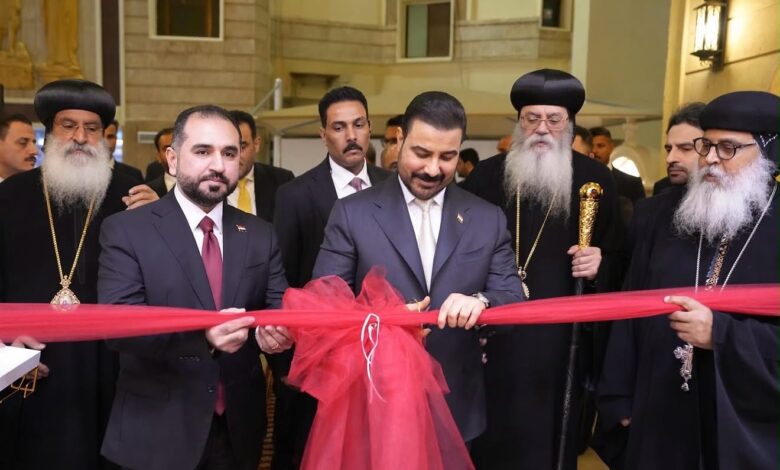
BAGHDAD, Iraq — The inauguration of a new Coptic Orthodox cathedral in Baghdad on Thursday became an occasion for Iraqi Prime Minister Ali Faleh Al-Zaidi to present a wider vision for the country’s future, connecting religious tolerance and national unity with security reforms, economic development, and international cooperation.
Speaking at the opening of the Cathedral of the Virgin Mary, Anba Paula, and Anba Antonios, Al-Zaidi emphasized the importance of protecting Iraq’s religious and cultural diversity while strengthening state institutions and creating new economic opportunities.
The ceremony brought together government officials and Christian religious leaders, marking an important occasion for Iraq’s Coptic Orthodox community.
Beyond the cathedral’s religious significance, the Prime Minister used the occasion to outline several government priorities, including combating corruption, strengthening national security, expanding housing opportunities, developing industrial cities, and increasing Iraq’s role in regional commerce.
Religious Diversity as a Foundation for National Unity
The cathedral’s opening carries particular significance in a country where religious communities have endured years of conflict, displacement, and political instability.
Al-Zaidi described Iraq’s cultural and religious diversity as a national strength, emphasizing that the country’s shared identity should overcome attempts to divide its population along religious or political lines.
He reaffirmed his government’s commitment to protecting the rights of all Iraqis, regardless of their religious or social backgrounds.
The cathedral, dedicated to the Virgin Mary and two prominent Coptic saints, represents another milestone for the Coptic Orthodox community in Iraq.
Its opening also reflects the longstanding historical and cultural connections between Iraq and Egypt, where the Coptic Orthodox Church has its roots.
For Iraq, the ceremony offered an opportunity to reinforce a message of coexistence at a time when political stability and social cohesion remain central to the country’s recovery.
However, preserving religious pluralism requires more than public commitments. It also depends on effective legal protections, community security, and the ability of minority populations to participate fully in national life.
Strengthening Security and State Institutions
Addressing the country’s security priorities, Al-Zaidi reiterated his government’s determination to combat corruption and strengthen the state’s authority over armed groups.
He emphasized that building a stable Iraq requires stronger institutions grounded in security, economic opportunity, and the rule of law.
The government’s stated objective of ensuring that weapons remain under state authority continues to be an important issue in Iraq’s broader security debate.
Political stability also remains closely connected to the country’s economic ambitions, as investors and development partners evaluate the risks associated with financing major infrastructure projects.
Al-Zaidi further emphasized the importance of maintaining international relationships based on Iraq’s national interests, sovereignty, and territorial integrity.
His remarks reflected an effort to position Iraq as a country pursuing domestic stability while strengthening its economic and diplomatic relationships abroad.
Housing and Agricultural Development Among Government Priorities
The Prime Minister also highlighted his administration’s plans to address housing shortages and expand access to economic opportunities.
A central component is the Watan Initiative, which aims to provide one million residential land plots for Iraqi families without homes.
Al-Zaidi said the government intends to advance the initiative across Iraq’s governorates, alongside other development projects aimed at improving living conditions.
Government reporting indicates that groundwork has already begun in several provinces, although the wider initiative remains under implementation.
The administration has also announced agricultural land development measures designed to strengthen food security, increase domestic production, and generate employment.
These initiatives form part of an effort to connect public investment with practical improvements in housing, employment, and essential services.
Their eventual impact will depend on financing, infrastructure readiness, transparent distribution procedures, and implementation across the country.
New Industrial Cities and Investment Opportunities
In outlining his economic strategy, Al-Zaidi discussed plans to develop new economic, industrial, and administrative cities that could serve as centers for investment and commercial growth.
The proposed developments are intended to encourage business activity, support domestic production, and create additional employment opportunities.
Expanding Iraq’s economic base remains a significant priority for a country that has historically depended heavily on oil revenues to finance government spending.
The Prime Minister also referred to the Generations Fund, a government initiative intended to direct national financial resources toward strategic investments and long-term development.
The government has previously announced plans to strengthen the fund using resources recovered through anti-corruption efforts.
Whether these initiatives deliver sustainable economic benefits will depend on their governance, financial oversight, and ability to attract productive investment.
Iraq’s Development Road and Regional Trade Ambitions
One of the most internationally significant elements of Al-Zaidi’s remarks concerned the Development Road project, a planned transportation corridor that could transform Iraq’s position in regional trade.
The initiative aims to connect the Grand Faw Port in southern Iraq with the Turkish border through an extensive railway and road network, creating potential commercial links between Gulf markets, Türkiye, and Europe.
The project has attracted regional attention because of its potential to improve freight transportation, reduce logistical costs, and support industrial development.
Iraq has pursued cooperation with Türkiye, Qatar, and the United Arab Emirates in advancing the initiative.
For Baghdad, the Development Road represents more than a transportation project. It is part of a broader strategy to diversify economic activity, attract international investment, and strengthen Iraq’s commercial relationships.
Successful implementation would require substantial financing, cross-border coordination, modern transportation infrastructure, and sustained regional stability.
The initiative could also create opportunities for logistics businesses, industrial manufacturers, and investors seeking access to emerging regional trade networks.
A Vision That Extends Beyond the Cathedral
Al-Zaidi’s address brought together themes that are often discussed separately in Iraq: religious coexistence, national security, institutional reform, and economic development.
By presenting these priorities during a Christian religious ceremony, the Prime Minister placed national unity at the center of his government’s broader political and economic message.
The opening of the cathedral offered a symbolic reminder of Iraq’s religious heritage and the importance of protecting communities that have contributed to the country’s history.
At the same time, the government’s development announcements highlighted the practical challenges Iraq faces in translating political commitments into measurable improvements in daily life.
For Iraq’s future, the central test will be whether efforts to strengthen institutions, improve security, expand housing, and modernize transportation can produce lasting results.
The Prime Minister’s message presented religious coexistence and economic prosperity as connected elements of national recovery.
Turning that vision into reality will depend on the government’s ability to deliver reforms, protect the rights of its diverse communities, and create the conditions for long-term stability and investment.